CNN founder didn't just create 24-hour news. He invented the always-on channel stack — and Korea's ATSC 3.0 transition is its newest test case.
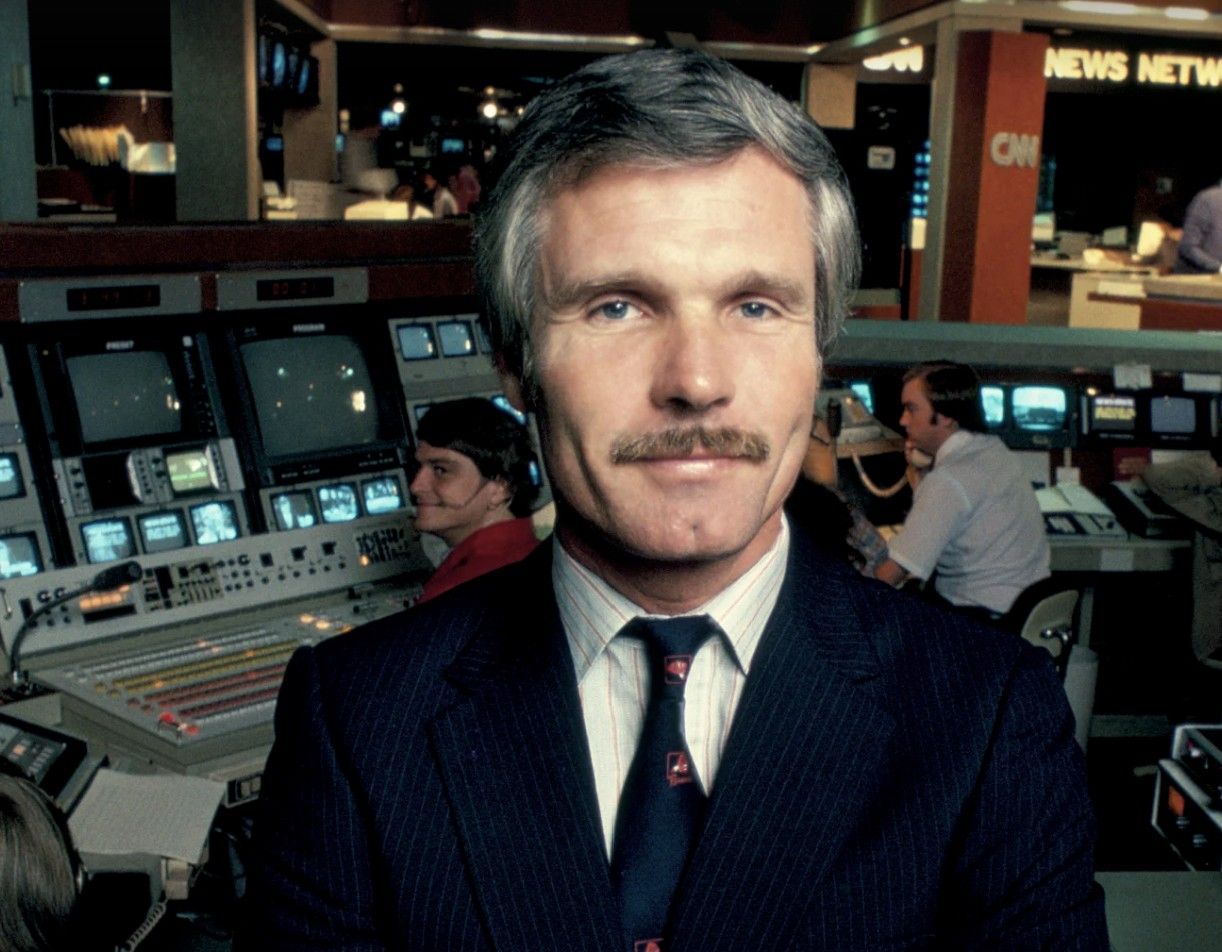
The cable era's most consequential architect has died. Ted Turner, founder of CNN (Cable News Network) and the man who created the 24-hour news cycle, passed away on Wednesday at his home near Tallahassee, Florida. He was 87.
Family spokesman Phillip Evans confirmed the death. Turner had disclosed in 2018 that he was suffering from Lewy body dementia, a progressive brain disorder he later said had been mistaken for years as bipolar disorder.
But for Korean broadcasting — and for any market now staring down its own ATSC 3.0 and FAST transition — the more consequential story isn't the man's death. It's the business model he leaves behind.
Between 1976 and 2001, Turner invented a four-layer stack — satellite distribution + cable carriage + genre-specific channels + permanent IP library — that has been replicated, more or less verbatim, by every cable empire that followed: Fox News, MSNBC, Discovery, HBO. Today's blueprint for the "always-on" channel business on OTT, FAST and ATSC 3.0 traces back, almost line for line, to a control room in Atlanta on the morning of June 1, 1980.
"Lead, follow, or get out of the way." — Ted Turner's lifelong motto
1. Why 1980 Worked — Exploiting a Structural Gap in Cable
Turner's breakthrough was made possible by a structural gap in the late-1970s U.S. cable industry. Cable operators desperately needed content to differentiate themselves from the three broadcast giants (ABC, NBC, CBS), but their own production capacity was thin. The supply void was the opportunity.
Turner identified the gap with surgical precision. In late 1976, he leased an RCA satellite to beam the signal of his small Atlanta station, WTCG, to cable operators across the country. It was a U.S. first. On top of that same satellite-and-cable backbone, he then layered, one by one, a portfolio of genre channels: 24-hour news (CNN), film and drama (TNT, TCM), animation (Cartoon Network), and a deep classic-film IP library (acquired through MGM).
Turner's real legacy, in other words, is not CNN as a single channel. It is the four-layer stack — satellite + cable + genre channels + IP library — as a business model in itself. The explosive cable growth of the 1980s, the global channel boom of the 1990s, and the multi-channel pay-TV market of the 2000s were all built on this architecture. By 1989, Turner's personal fortune had doubled to roughly $5 billion, and CNN plus CNN Headline News reached more than 50 million households worldwide.
2. From Birth to Tragedy — His Father's Suicide and the Birth of a "Superachiever"
Born Robert Edward Turner III in Cincinnati on November 19, 1938, Turner was raised primarily in Georgia, where his father Ed Turner ran a billboard advertising business after relocating from Mississippi during the Depression. As a boy, Ted cut weeds in front of billboards and helped the painters.
The relationship with his father shaped the rest of his life. In his autobiography Call Me Ted, he described his father as abusive when drinking, but also as the man whose approval he chased relentlessly. Even Turner's choice to study classics at Brown University irritated his father, who believed it would not serve a business career and reportedly questioned in a letter whether "oddball professors" and ivory towers were producing the kind of son he could be proud of.
Turner himself was no model student. He was suspended from Brown for throwing chairs out of a dorm window after drinking; classmates later recalled that he sang Nazi songs outside a Jewish fraternity and put up KKK signs on Black students' dormitory doors. He left Brown without a degree.
The deeper tragedy came in the family. In 1963, his 53-year-old father — overwhelmed by debt anxiety and substance abuse — impulsively agreed to sell off part of the company and, days later, shot himself in the bathtub. Ted was 24. He had also recently lost his younger sister Mary Jean to lupus and encephalitis, an experience he later said cost him his religious faith and made him publicly antireligious for life. He cited the same losses as the engine that turned him into what he called a "superachiever."
3. From Billboards to Broadcasting — The Bir
📎 Read full article on K-EnterTech Hub →
About K-EnterTech Forum · K-엔터테크포럼
K-EnterTech Forum (K-ETF, K-엔터테크포럼)은 엔터테인먼트 테크놀로지, K-콘텐츠, 한류, 미디어 정책 분야의 전문 인사이트를 제공하는 국내 대표 플랫폼입니다. K-팝·K-드라마·K-푸드·K-컬처와 AI·스트리밍·크리에이터 이코노미·방송 기술의 공진화(Co-Evolution) 전략을 연구하고, 국내외 포럼·행사를 통해 정책 및 산업 협력 의제를 이끌고 있습니다.
K-EnterTech Forum is Korea's leading platform for insights on entertainment technology, K-Content, Hallyu, and media policy — bridging Korean cultural industries with global technology trends.
고삼석 상임의장 · Chairman Samseog Ko
고삼석(Ko Samseog)은 K-EnterTech Forum 상임의장입니다. 동국대학교 첨단융합대학 석좌교수이자 국가인공지능전략위원회 분과위원으로, 30년 이상의 방송통신 정책 및 산업 경험을 바탕으로 K-콘텐츠와 글로벌 엔터테인먼트 기술의 융합을 선도하고 있습니다. 前 방송통신위원회 상임위원을 역임했으며, ZDNet Korea에 정기 칼럼을 연재 중입니다.
Samseog Ko is the founding Chairman (상임의장) of K-EnterTech Forum. He is a Distinguished Professor at Dongguk University and a member of Korea's National AI Strategy Committee. Former Commissioner of the Korea Communications Commission (KCC).
📩 familygang@naver.com | 🌐 entertechfrum.com | 고삼석 상임의장 소개 →
![[긴급 모집] 美 플로리다 Early Stage Venture Conference 2026 한국 기업 참가사 공모](https://cdn.media.bluedot.so/bluedot.kentertechhub/2026/05/do2kax_202605172336.jpg)